
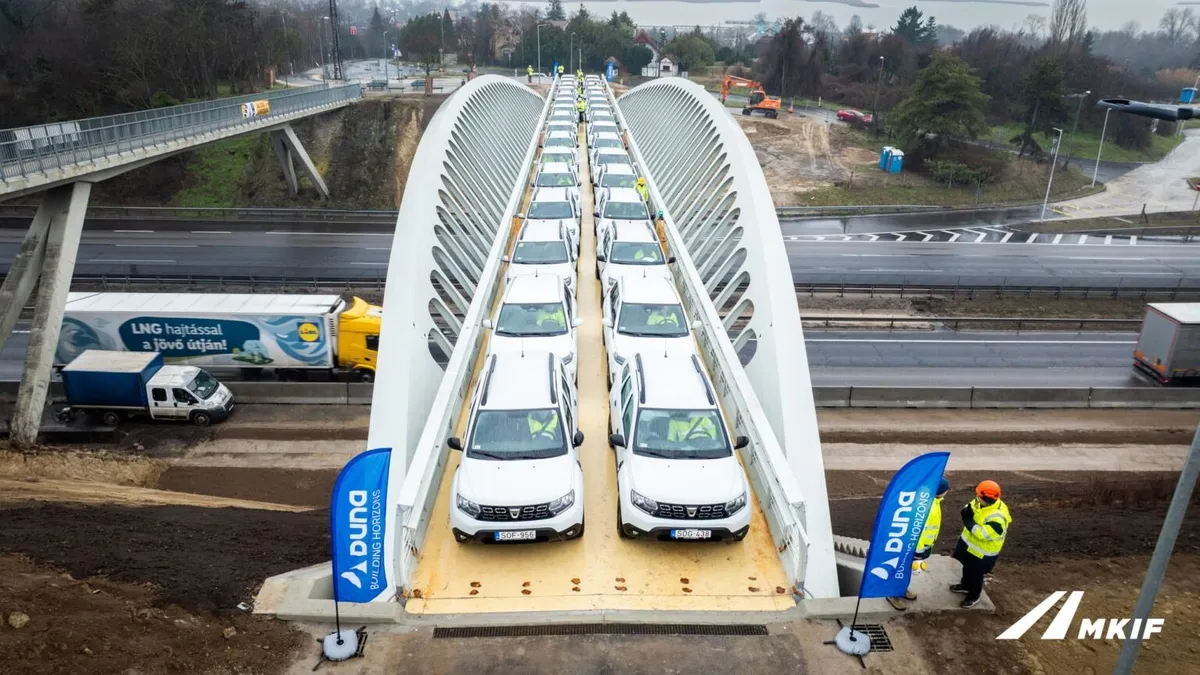
Successful Load Testing of the New Pedestrian and Bicycle Bridge over the M7
Recently, the load testing of a newly constructed pedestrian and bicycle bridge near Velence, which spans over the M7 motorway, was successfully completed. This significant engineering task was carried out by experts and engineers from the Department of Bridges and Structures at the Budapest University of Technology and Economics in collaboration with the construction company.
The load test was designed to analyze both the static and dynamic behavior of the bridge structure. According to reports, the structure passed the test with flying colors. The test involved subjecting the bridge to various static loads initially, followed by dynamic tests where the effect of pedestrians moving at different speeds was assessed on the bridge.
The main objective of the load testing was to verify that the finished bridge meets the specified load classifications determined during the design phase. Results from the testing were compared with static models to ensure that the structure’s behavior aligned with engineering predictions, and the dynamic characteristics of the structure were also measured by the engineers.
Prior to the first loading and afterward, the condition of the bridge was thoroughly inspected to ensure no harmful deformations, cracks, or alterations had developed in the substructure or structural elements. Special measuring devices were used to record how the structure reacted to different loading scenarios. A maximum load of 32 cars, approximating 50 tons, was positioned on the bridge simultaneously during this testing phase.
A variety of conditions were recreated to test the bridge’s robustness against potential real-world stresses, including scenarios expected to be rare during regular usage. The testing not only included observing displacements and elongations but also measurements related to the bridge’s natural frequency and pedestrian dynamics.
The successful completion of this load test is a crucial step towards the official commissioning of the bridge. Following this, the necessary protocol for placing the bridge into service will be initiated by the National Transport Authority, contingent on the issuance of a compliance certificate based on the test results.
Even though the bridge surpassed the load testing requirements, it remains an active construction site, and access is prohibited until formal approval is granted.
As reported by a reputable source, this elegantly designed bridge, which is part of the Budapest-Balaton bicycle route, is set to enhance the area’s tourism appeal. Designed by Főmterv Engineering Design Ltd., the bridge measures 80 meters in length, 4.5 meters in width, and weighs 193 tons. It was transported to the site in eight segments, which were subsequently joined together during installation.